Table of Contents
In this blog, we explain why WooCommerce discounts often increase sales numbers while quietly reducing actual profit. We break down how discount-driven profit loss happens, why it is easy to miss in reports, and the three common ways discounts weaken margins over time.
Key Takeaways
- Discounts often increase sales numbers but reduce profit.
- Profit loss is easy to miss because revenue and order counts still grow.
- Blanket discounts affect every order, even when they are not needed.
- Limited discounts protect profit by applying only in specific situations.
- Clear rules help discounts support growth instead of weakening the business.
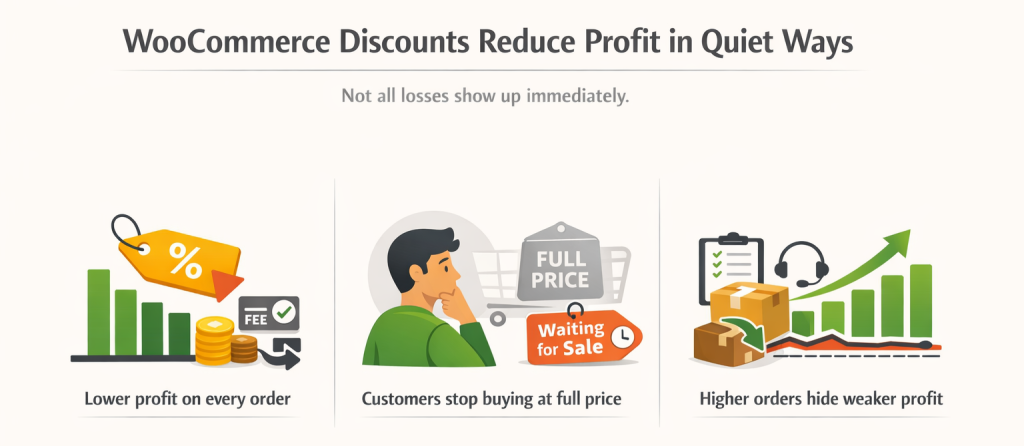
In most WooCommerce stores, discounts reduce profit more than they increase revenue.
When a product is discounted, the store earns less money on every order. At the same time, customers start expecting lower prices and become less willing to buy at full price later. Both effects happen together.
This creates confusion because sales numbers still look good.
Revenue shows how much money comes in from orders. Profit shows how much money is left after discounts, product costs, and the cost of running the store. Discounts increase revenue numbers while reducing what the business actually keeps.
What discount-driven profit loss means in WooCommerce
Discount-driven profit loss happens when discounts increase sales activity but reduce the amount of profit earned from each order.
In WooCommerce, this occurs because discounts lower the product price while most costs stay the same. Product costs, payment fees, shipping, and returns do not decrease when a discount is applied. As a result, the store keeps less money from every sale.
At the same time, discounts often increase order volume. More orders lead to higher revenue numbers and higher order counts, even when the profit from each order is smaller.
Example
A product sells for ₹1,000.
- Product cost: ₹600
- Payment and other fees: ₹100
Profit without a discount: ₹300
Now the store offers a 20% discount.
- New price: ₹800
- Product cost: ₹600
- Fees: ₹100
Profit after discount: ₹100
The profit per order drops by ₹200.
If the discount doubles the number of orders, revenue may increase. But the store now needs three discounted orders to earn the same profit as one full-price order.
Because of this pattern, profit loss is easy to miss. Sales reports improve, while the actual money left after costs stays flat or decreases.
How WooCommerce discounts quietly reduce profit in 3 common ways
Discounts reduce profit in more than one way. Some effects are immediate. Others appear slowly and are easier to miss.
1. Lower profit on every order
When a discount is applied, the store earns less money from each sale.
This impact is strongest when:
- product margins are already low
- discounts apply to all customers
- the same products are discounted often
Even a small price cut can remove a large part of the profit after payment fees, shipping, and returns are counted.
2. Customers stop buying at full price
Frequent discounts change buying behavior over time.
As discounts become common:
- customers wait for sales instead of buying right away
- full-price orders become less frequent
- discounts feel expected rather than occasional
This reduces the value of future sales, even during periods with no active discount.
3. Higher order count hides weaker sales quality
Discounts often increase the number of orders placed. This makes the store appear more active.
In many cases:
- discounted orders bring in less profit
- returns and support requests increase
- more work is required to earn the same money
The store processes more orders, but keeps less profit overall.
These three effects often happen together. They explain why WooCommerce discounts can damage profit even when sales numbers look strong.
Practical WooCommerce scenarios where profit is commonly lost
Profit loss from discounts usually happens in familiar situations. These patterns appear across many WooCommerce stores.
Storewide sales on already discounted products
Many stores run a sitewide sale without checking which products are included.
When this happens:
- products with low margins get discounted again
- profit drops faster than expected
- best-selling items become the biggest profit drain
The store sells more, but earns much less from its most popular products.
First-time buyer discounts with no limits
First-time buyer discounts are often applied to every new customer automatically.
This creates two problems:
- customers buy once and do not return
- low-value orders increase
- full-price purchases become rare
The discount attracts orders, but not long-term customers.
High-traffic campaigns on low-margin products
Some campaigns focus on driving traffic to products with thin margins.
In these cases:
- marketing costs stay high
- discounts reduce profit even further
- increased volume does not fix the margin gap
The store appears busy during the campaign, but keeps very little profit from it.
When discounts actually make sense in WooCommerce
Discounts are not always harmful. Problems start when discounts are applied without limits or a clear reason.
Discounts work better when they solve a specific problem instead of being used as a general sales tactic.
In fact, one source noted a whopping 73% spike in sales simply by offering strategic discounts.
Common situations where discounts make sense include:
- clearing products that are not selling
- encouraging customers to buy more items
- offering special pricing to repeat or wholesale customers
In these cases, the discount dynamically applies only under certain conditions. It does not affect every product or every customer.
The key difference is how wide the discount applies. Limited discounts change behavior in a small, controlled way. Blanket discounts reduce profit across the entire store.
Better alternatives to blanket WooCommerce discounts
Blanket discounts reduce prices for everyone, even when it is not needed.
A better approach is to lower prices only when there is a clear reason. This protects profit while still encouraging customers to buy.
In WooCommerce, this usually means applying discounts only in specific situations i.e. conditional discounts.
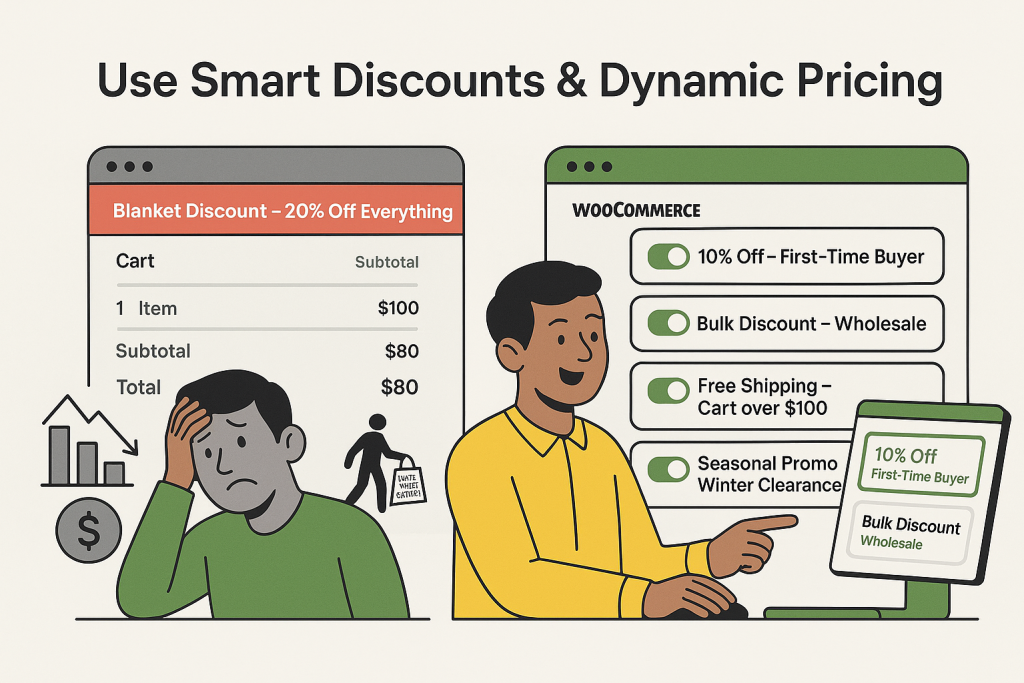
Common examples include:
- giving a discount when customers buy more items
- lowering prices only for products that are not selling
- offering special prices only to specific customers
In these cases, the discount applies only when certain conditions are met. Other customers continue to see the normal price.
This limits profit loss. The store does not reduce earnings on every order, only on the orders where the discount makes sense.
Instead of relying on storewide sales, this approach uses smaller, limited discounts that support sales without damaging profit.
A simple checklist before running a WooCommerce discount
Before applying a discount, it helps to pause and check a few basic points. This prevents unnecessary profit loss and makes the outcome more predictable.
Ask the following questions.
- Is this product already low on profit?
If the margin is thin, even a small discount can remove most of the earnings from each sale. - Is the discount needed for every customer?
If only some customers need an incentive, applying the discount storewide may reduce profit without adding value. - Will this discount apply to my best-selling products?
Discounting top sellers often reduces profit faster than expected because these products already sell without price cuts. - What behavior am I trying to change?
Discounts work best when they encourage a specific action, such as buying more items or clearing slow-moving stock. - Can I afford lower profit if order volume increases?
More orders mean more shipping, support, and returns. Higher volume does not always balance lower profit.
If these questions do not have clear answers, running a discount is likely to reduce profit rather than help the store.
The Ultimate profit-safe WooCommerce discount setup
The core problem is simple: most discounts fail because they are too wide. They apply to too many products, too many customers, and too many orders.
The fix is not “stop discounting.” The fix is make discounting rule-based.
That is exactly what WooCommerce Dynamic Pricing and Discount Rules is built for. It lets you create discount rules that apply only when conditions are met, so discounts drive sales without reducing profit across every order.
WooCommerce Dynamic Pricing and Discount
Apply advanced discount conditions to drive more revenue with our intuitive and easy-to-use plugin.
14-day, no-questions-asked money-back guarantee.
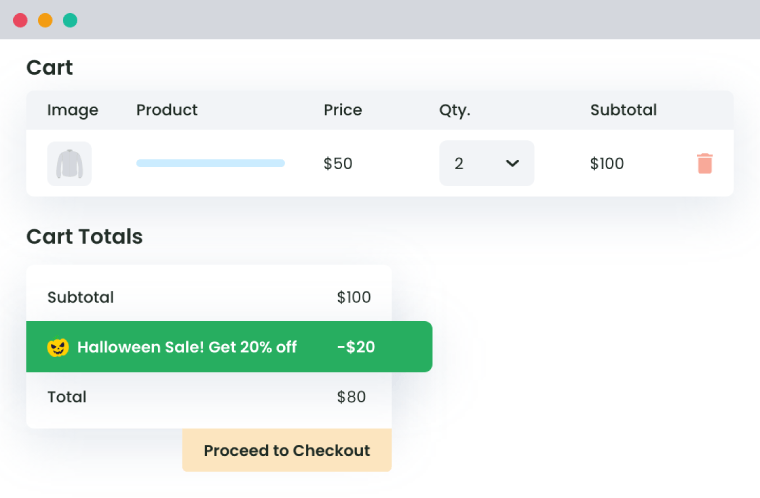
What this plugin helps you control (so profit stays protected)
With Dynamic Pricing and Discount Rules, you can create discounts based on:
- customer type and behavior (example: first-time buyers)
- cart conditions (example: subtotal, quantity, what’s in the cart)
- product targeting (example: specific products, tags, categories)
And you can apply different discount types like:
- fixed discounts
- percentage discounts
- BOGO deals
- volume and quantity-based discounts
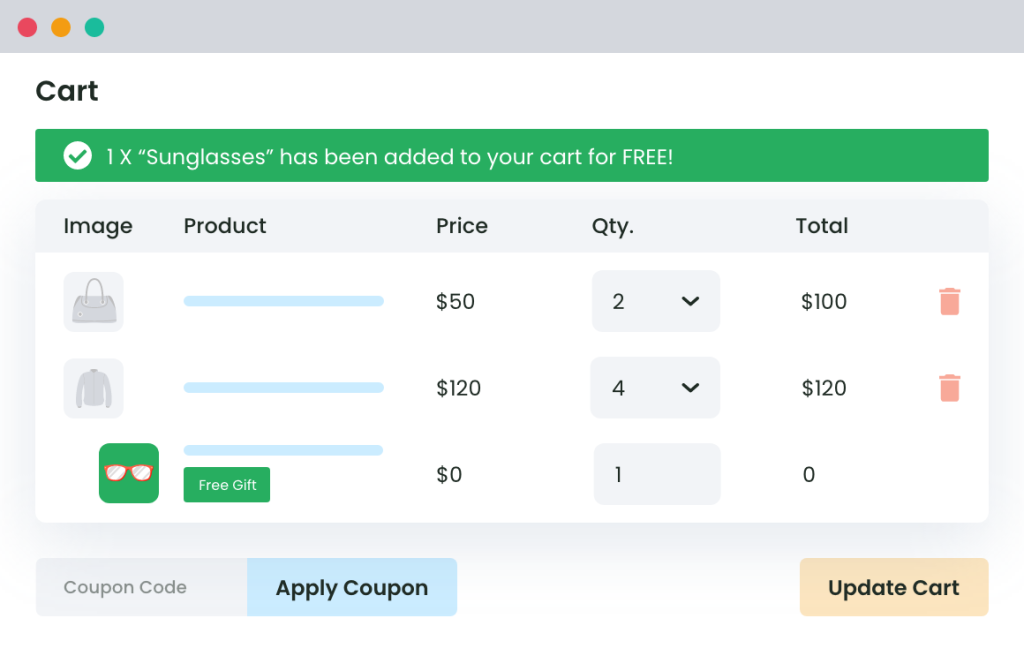
How it solves the exact profit problems covered in this blog
1) It prevents blanket discounts
Instead of “20% off everything,” you can apply discounts only where they make business sense.
That means your best sellers can stay full price while only selected products receive a discount.
2) It limits discounts to high-intent actions
Instead of discounting every order, you can reward the actions that improve profit, like:
- buying more items in one order
- reaching a certain cart value
- purchasing from specific categories
This reduces the “more orders, less profit” pattern.
3) It removes the need for constant coupon campaigns
If your discount rules are automatic, you don’t need to run storewide coupon pushes to maintain sales momentum.
The store stays consistent, and the discount logic stays controlled.
Practical examples that match real store situations
- First-time buyer discount without training everyone to wait for sales
Apply a discount only when the plugin detects it is the customer’s first order. - Quantity discount that protects margin
Apply a better price only when the cart quantity crosses a threshold, not on single-item orders. - Targeted category discounts without discounting the whole store
Apply discount rules only on selected products or product tags.
If you want discounting to increase sales without quietly reducing profit, this rule-based approach is the safest way to do it.
Dynamic Pricing and Discount Rules should be treated as the main system for running discounts in WooCommerce. It controls how wide a discount spreads, when it applies, and which orders receive it.
This directly solves the core problems covered earlier in this blog:
- discounts affecting every order
- best-selling products losing margin
- customers learning to wait for sales
- more orders with weaker profit
The ultimate add-on to grow revenue without more discounts
Discounting is not the only way to grow revenue. Often, a cleaner and safer path is increasing how much each order is worth.
This is where Revenue Booster for WooCommerce fits.
Instead of lowering prices, Revenue Booster increases average order value by showing small, relevant offers during and after checkout. These offers add to the order instead of reducing the price of the main product.
Revenue Booster for WooCommerce
Increase your average order value by using proven techniques like ‘frequently bought together’ and ‘order bumps’ with the WooCommerce Revenue Booster plugin.
14-day, no-questions-asked money-back guarantee.
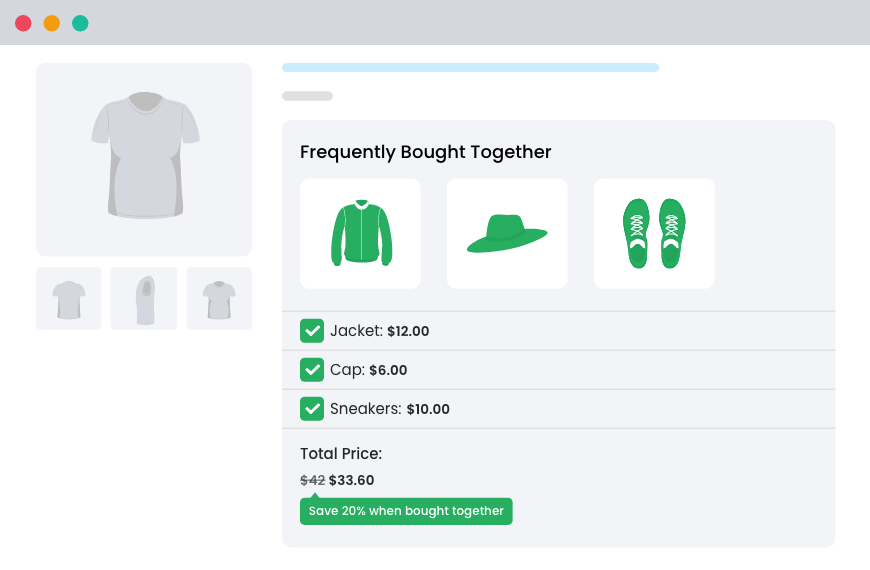
Common examples include:
- frequently bought together suggestions
- small add-ons shown at checkout
- post-purchase offers shown after the order is placed
Why this matters in a profit-protection setup
When order value increases, the store depends less on discounts to grow.
Instead of pushing “20% off storewide,” the store can:
- keep product prices stable
- add relevant items to the cart
- earn more from each order without cutting margins
For example: A customer is about to buy one item. Revenue Booster can suggest one more related product:
- as a bundle offer
- or as a small add-on at checkout
The customer buys more, but the main product price stays the same.
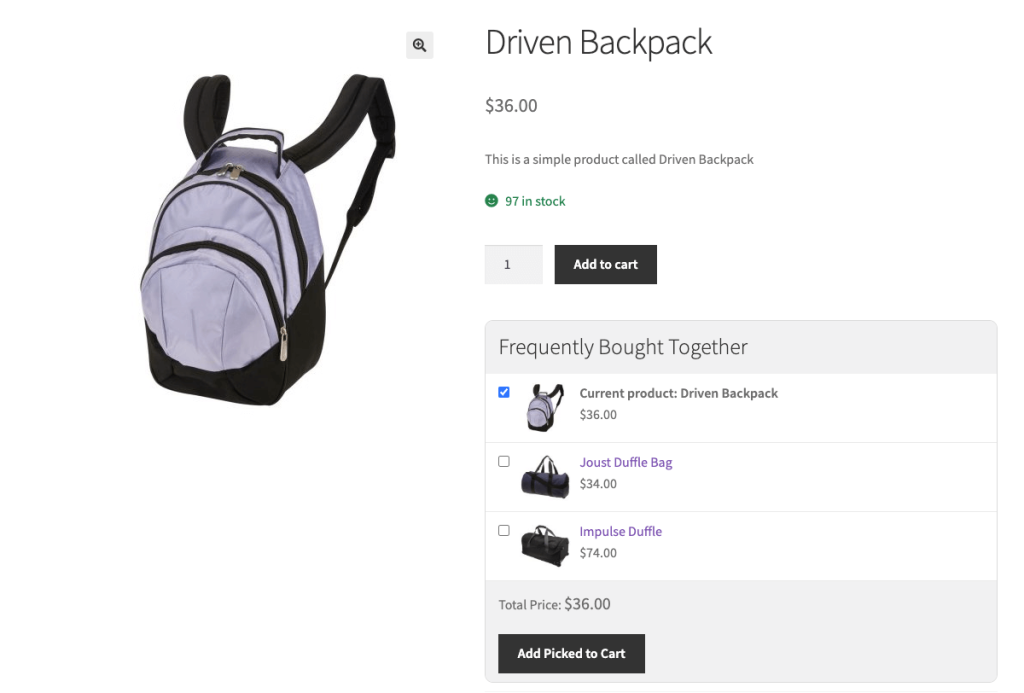
This increases revenue from the same customer without creating long-term price expectations.
Dynamic Pricing and Discount Rules control when discounts apply. Revenue Booster increases order value without relying on deeper discounts.
That is why Revenue Booster works best as a second layer.
Conclusion: How to grow without letting discounts hurt profit
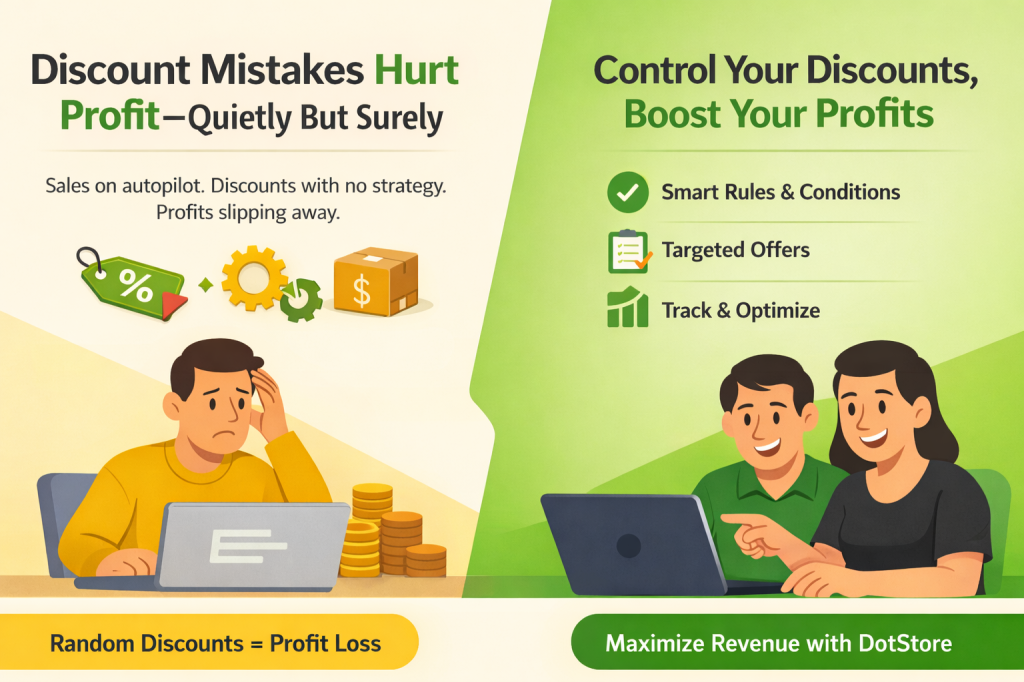
Sales might increase, order counts can rise, and reports might look healthy. But profit quietly keeps slipping away because prices are lowered too often and too widely.
The fix is running better discounts that are limited, targeted, and tied to a clear reason. They fail when they apply to every product, every customer, and every order.
Controlling when discounts apply protects profit. Increasing order value reduces the need to discount at all. When these two ideas work together, WooCommerce stores can grow without the hidden cost that storewide discounts create.