Table of Contents
We spend every day answering WooCommerce store owners, so we decided to read the archive and count.
Across about 4,500 real support conversations sent to Dotstore between June 2024 and September 2026, the most common WooCommerce problems that bring merchants to support are store owners trying to make WooCommerce do something it cannot do on its own.
The pattern was remarkably consistent: the same six problems, in the same order, every time we measured.
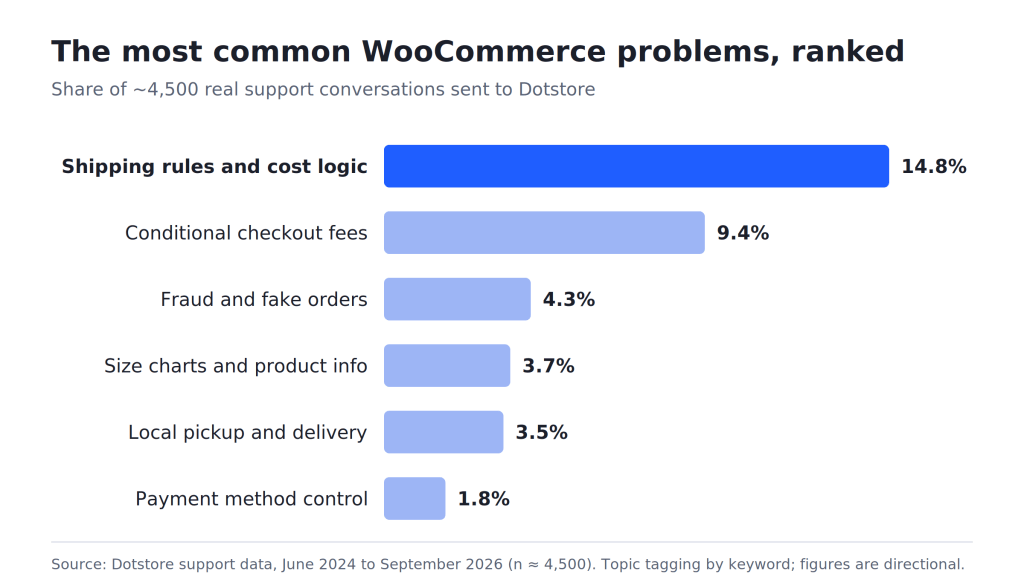
In Dotstore’s analysis of ~4,500 WooCommerce support conversations, shipping was the single most common problem, at about 15 percent of all requests, followed by conditional checkout fees at about 9 percent.
Here is the full ranking, why these problems cluster the way they do, how to solve each one, and exactly how we counted.
The finding, in one line: Dotstore’s study of ~4,500 real WooCommerce support conversations (2024 to 2026) found shipping is the most common merchant problem (~15%), ahead of conditional checkout fees (~9%) and fraud or fake orders (~4%). Most of the top issues share one root cause: WooCommerce does not give store owners rule-based control over checkout and fulfillment.
Where does this WooCommerce support data come from?
This study is first-party data, not a survey and not scraped forum posts. Every data point is a real WooCommerce store owner who wrote to Dotstore support with a real problem, which is what separates it from the usual “top WooCommerce issues” list.
- Source: Dotstore’s own WooCommerce support inbox.
- Sample: about 4,500 conversations
- Window: June 2024 to September 2026.
- Who: real store owners across a global user base, captured the moment they hit a wall.
We build WooCommerce plugins across each of the areas below, which is why merchants in these areas reach us. We counted what they asked about, not what they bought.
What are the most common WooCommerce problems?
The requests sort cleanly into six recurring areas, and shipping dominates. It generates more support demand than the next two problems combined.
According to Dotstore’s support data, shipping is the number one WooCommerce problem by a wide margin, roughly 1.5 times the second-ranked issue and about 4 times the volume of fraud.
| Rank | Problem | Share |
| 1 | Shipping rules and cost logic | 14.8% |
| 2 | Conditional checkout fees | 9.4% |
| 3 | Fraud and fake orders | 4.3% |
| 4 | Size charts and product info | 3.7% |
| 5 | Local pickup and delivery | 3.5% |
| 6 | Payment method control | 1.8% |
Key takeaway: According to Dotstore’s support data, shipping is the number one WooCommerce problem by a wide margin, over 1.5 times the second-ranked issue and more than three times the volume of fraud.
What is the number one WooCommerce problem?
Shipping. In Dotstore’s analysis of ~4,500 support conversations, shipping rules and cost logic accounted for about 15% of all requests, making it the most common WooCommerce problem by a clear margin.
Most of these are merchants trying to price shipping by weight, product category, or zone combinations, which WooCommerce does not support natively.
The most common WooCommerce shipping problems, based on Dotstore’s support data, break down into five recurring issues:
- Controlling which options show: hiding a shipping method in specific cases, such as hiding FedEx for certain products, or hiding paid shipping once an order qualifies for free shipping.
- Rates that don’t appear: a shipping rule is set up, but no rate shows at checkout.
- Free shipping clashing with tax: free shipping turns on but keeps overriding the tax that should still apply.
- Different rates by region or zip code: setting rates for specific zip-code areas and treating everywhere else differently.
- Pricing by product type or weight: charging shipping based on a product’s category and its weight combined.
All five come down to the same gap: store owners can set a simple rate, but not one that changes based on what’s in the cart or where it’s going.
Shipping problems rarely come alone. In Dotstore’s data, shipping issues often overlapped with other checkout settings:
- With local pickup: about 5% of shipping tickets also involved pickup, like offering store pickup for one country while shipping everywhere else.
- With payment methods: about 5% also touched payment, such as charging shipping differently for cash on delivery.
- With tax: about 4% also ran into the shipping-and-tax clash described above.
The pattern: shipping is not an isolated setting. It is part of one connected checkout system, which is why changing one rule so often breaks another.
How common are fake orders on WooCommerce?
Fake and fraudulent orders ranked third in Dotstore’s study, at about 4% of support conversations, and are the most common security-related problem store owners raise. Merchants most often ask to block them automatically rather than review each order by hand.
Why do WooCommerce store owners keep hitting the same problems?
Because most of them are the same problem in different clothes. One store wants to charge more to ship a heavy item. Another wants to add a small fee only on cash-on-delivery orders. A third wants a payment option to show only for certain products.
Each one is really the same request: a rule that says “do this, but only in this situation.” WooCommerce handles the simple version and stops at the rule, which is why four of the six problems above are versions of the same thing.
Can WooCommerce handle conditional shipping and fees without a plugin?
Not out of the box. WooCommerce core is built to handle the common case well and to leave the rest to extensions.
Shipping zones assume one rate per zone. The fee and payment APIs expose simple defaults, and anything conditional has to be added through hooks or custom code. So the moment a merchant’s real-world rule gets more specific than the default, the platform stops and the merchant starts looking for help. That is the gap this data keeps pointing at.
What does this mean for WooCommerce store owners?
If you run a WooCommerce store, this data is a priority list. Shipping and checkout rules cause the most friction, so get those right first. And notice what the data is really saying: your hardest moments usually are not WooCommerce breaking. They are the point where your store’s rules outgrow the default settings.
If you decide early how you will handle things like conditional shipping, fees, and payments, you avoid the scramble later.
There is a second lesson in the data. In a hand-labeled sample, about 65 percent of resolved tickets were answered by pointing to documentation that already existed. For merchants, that means the answer to most problems already exists if you know where to look. For the ecosystem, it means clear, honest guidance prevents more pain than any single feature.
How do you fix the most common WooCommerce problems?
Here is the honest version of what WooCommerce can and cannot do in each area, so you can solve as much as possible yourself. Each links to a full step-by-step guide.
- Shipping rules: Native WooCommerce gives you flat rates per zone and basic free-shipping conditions. It cannot price by weight bands, product category, or combined conditions without help. For those, see our complete shipping rules guide.
- Conditional fees: WooCommerce has no built-in conditional fee at checkout. Developers can add one with the
woocommerce_cart_calculate_feeshook, but there is no native UI for “add this fee only when.” See our checkout fees guide. - Fraud and fake orders: Native tools stop at manual order review and whatever your payment gateway flags. There is no native blacklist by IP, email, or country, and no automatic risk scoring. See our fraud prevention guide.
- Size charts: WooCommerce has no size-chart feature. You can hand-build one in the product description, but not reuse it by category. See our size chart guide.
- Local pickup: Native local pickup is a single basic option. It cannot offer multiple named locations or let customers choose a pickup date. See our local pickup guide.
- Payment method control: WooCommerce shows every active gateway to every customer, with no native way to show or hide methods by product, cart, or country.
Where native WooCommerce runs out, Dotstore builds no-code plugins for each of these areas.
How to cite this study:
You are welcome to reference this research. Please credit The Dotstore and link back to this page. For the underlying methodology or data questions, email us: support@thedotstore.com
Frequently Asked Questions
What is the most common WooCommerce problem?
Shipping. In Dotstore’s study of ~4,500 support conversations (2024 to 2026), shipping rules were the most common problem at about 15 percent, ahead of conditional checkout fees at about 9 percent.
What are the most common WooCommerce checkout problems?
Conditional fees and payment-method control. In Dotstore’s data, checkout fees were the second most common problem at about 9 percent, and controlling which payment methods appear added about 2 percent more. Both are rules WooCommerce cannot apply on its own.
What shipping rules does WooCommerce not support natively?
The rules merchants ask about most are pricing by weight, by product category, and by combined conditions, plus mixing free shipping with tax. WooCommerce core assumes one flat rate per zone, so these need an extension.
Are most WooCommerce problems bugs or setup issues?
Mostly setup and how-to, not platform bugs. In a hand-labeled sample of Dotstore tickets, about 65 percent were resolved by pointing to documentation that already existed, which points to configuration and knowledge gaps rather than defects.
What do WooCommerce store owners want for fraud protection?
Automation. Fraud and fake orders ranked third in Dotstore’s data at about 4 percent, and merchants most often ask to block bad orders automatically by IP, email, or country and to score each order for risk, rather than reviewing orders by hand.
Where does this WooCommerce study’s data come from?
Dotstore’s own support inbox: about 4,500 real conversations from WooCommerce store owners between June 2024 and September 2026. It is first-party data from real users, not a survey.